
This post was originally published by Blue Tomorrow, a Substack written and curated by the author. Reprinted with permission.
A fan of place-based education, every year I haul my students to Louisiana’s Maurepas Wildlife Management Area to paddle the swamps and learn about coastal law. I wrote about one of those trips in my last book, The Octopus in the Parking Garage. I described the setting this way:
A forty-odd-minute drive from New Orleans, Maurepas Swamp consists of about ninety- six square miles of flooded forest consisting mainly of water tupelo and bald cypress trees, the rootlike 'knees' of the latter poking out of the water like dragon’s teeth. Dripping with Spanish moss, their branches shade an under-story of wax myrtle, pumpkin ash, and an abundance of things that slide and crawl. Located within the 'Mississippi flyway,' the swamp provides rest stops for hundreds of species of transient songbirds, including warblers, cuckoos, vireos, and woodpeckers.
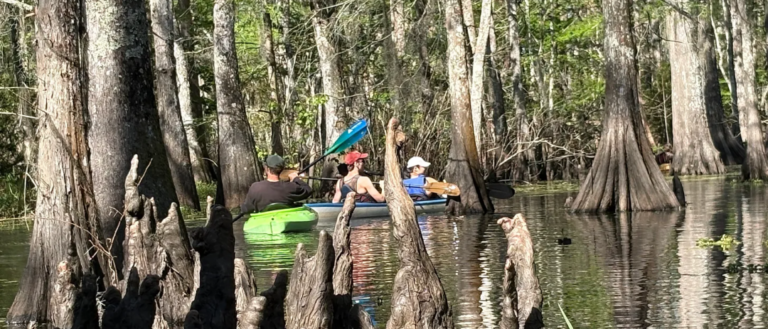
This semester, I had ten students with me, each paddling a kayak on the swamp’s shimmering water. Bits of salvinia, a free-floating aquatic fern, eased downstream at an almost imperceptible rate.
Stories on the bayou are always changing. This year, the narrative wrestled with a choice the state is making about what the Maurepas Swamp will become — an ecological jewel or a carbon-capture dump.
The community is torn.
On one hand, Maurepas is a story about re-discovery and recovery. For generations, this wetland had been harvested for the fur and timber markets. Cut off from the Mississippi River decades ago by levees and flood control, the swamp’s cypress and tupelo trees have suffered saltwater intrusion, subsidence, and a lack of nutrients. In the photo above, the landscape looks lush. After all, Maurepas is, for my money, one of the best paddling sites in the New Orleans area.
But look closely, and you’ll see thinning canopies, dying trunks, and water spreading where forests once stood.
There is reason for hope.
Louisiana’s Coastal Protection and Restoration Authority has started work on a $300 million river-diversion project that would send fresh water and some sediment from the Mississippi River into Maurepas Swamp. The initiative, which is mostly funded from fines associated with the BP oil spill, would stabilize and restore about 70 square miles of forested wetlands. This diversion is part of a multi-billion dollar effort to restore Louisiana’s coastal wetlands, whose imperiled state can be traced to levee development and the destructive activities of the oil and gas industry.
In our lifetime, I tell my students, Maurepas Swamp could become an ecological jewel.
But there’s a hitch.
Fossil fuel companies want to use subsurface formations beneath and around the wetlands to store captured carbon dioxide. Recently, state agencies approved a plan proposed by Air Products Blue Energy to construct a carbon dioxide pipeline through the Maurepas Swamp Wildlife Management Area. The pipeline would carry captured carbon dioxide through the wetlands and into a proposed carbon storage facility below Lake Maurepas. (Air Products manufactures ammonia and hydrogen through a process that creates lots of heat-trapping carbon dioxide. When manufacturers use carbon capture technology to dispose of that pollution, they call their product “blue ammonia” or “blue hydrogen.” Marketing is everything.)
As I’ve written elsewhere, carbon capture and storage (CCS) is a bad idea. The technology is unproven for this purpose; the process is prone to ruptures, leaks, and contamination; and the industry requires permanent government subsidies. According to the International Energy Agency, the technology’s future role in carbon reduction will likely be minimal.
Foisted on this struggling patch of public land, such industrialization seems like a disaster waiting to happen.
For this reason, the regional advocacy group Healthy Gulf is challenging the project in court. The group claims that when the state accepted the donations of tracts of land from private donors, it entered into agreements that include binding language making conservation the priority. I see other legal problems, too. It’s possible the agencies’ approval may have violated the state’s public trust doctrine or requirements in the state’s coastal-use permitting program (known as the State and Local Coastal Resources Management Act). We’ll see.
What Nature is forever teaching us here in the Pelican State is that you simply cannot have your swamp and eat it too. Wetlands like Maurepas Swamp are a blessing and a life support system.
If you’re hungry, I know a better way. I take my class to Middendorf’s.
Banner photo by the author, used here with permission.
Showing 2,947 results
Robert Verchick | March 30, 2026
A fan of place-based education, every year I haul my students to Louisiana’s Maurepas Wildlife Management Area to paddle the swamps and learn about coastal law. This semester, I had ten students with me, each paddling a kayak on the swamp’s shimmering water. Bits of salvinia, a free-floating aquatic fern, eased downstream at an almost imperceptible rate. Stories on the bayou are always changing. This year, the narrative wrestled with a choice the state is making about what the Maurepas Swamp will become — an ecological jewel or a carbon-capture dump. The community is torn.

Hannah Wiseman, Matthew McHale | March 23, 2026
In the past five years, the United States began experiencing a rapid increase in electricity demand, fueled primarily by data centers for artificial intelligence. A single data center can use the amount of electricity consumed by a city of approximately 80,000 people. Most data center companies seek electricity from the same utilities that provide electricity to retail and commercial customers (including all of us). And these utilities are building massive amounts of transmission and generation to meet data centers’ growing demands.
Robert Verchick | March 19, 2026
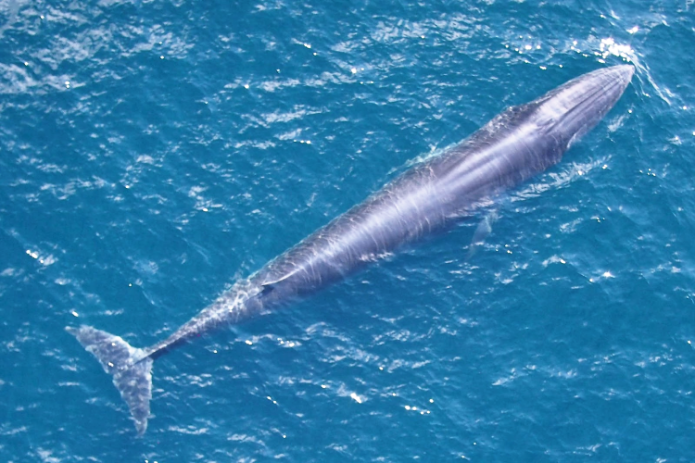
I was writing in a New Orleans coffee house last spring when another customer noticed the ocean stickers on my laptop and offered me a new one in support of a regional cause: the Rice’s whale, a species that had only recently been identified and is listed as endangered under the Endangered Species Act (ESA). That’s because only about 50 of these creatures exist. And they all live full-time in the Gulf of Mexico. I’ve seen many species of whales, but never this one. I’m told they have very distinct vocalization patterns and a unique diving pattern. Unlike many whales that feed near the surface, Rice's whales make deep dives toward the seafloor during the day to feed on fish and spend their nights sleeping within 50 feet of the surface. The Trump administration apparently wants them gone.

Brian Gumm, Bryan Dunning, Catalina Gonzalez, Federico Holm, James Goodwin, Rachel Mayo, Sophie Loeb, Spencer Green, Tara Quinonez | March 12, 2026
We mourn the lives of all Iranian civilians and U.S. service members lost in the illegal preemptive strike on Iran, and that of all civilians killed and hurt in subsequent strikes in the region. This war is continuing to fuel broader conflict and instability in the region and around the world. We join every American who objects to this war. Our planet can be a beautiful place, and stewarding and protecting all of its inhabitants and its natural resources is our noblest calling.

Daniel Farber | February 24, 2026
If the Trump EPA successfully repeals the endangerment findings for vehicles and stationary sources, states will be the only resort for climate action. A key question is how the repeals would impact state power relating to carbon emissions. The bottom line answers are: (1) the impact on state power to regulate tailpipe emissions seems unclear but could be positive; (2) there would be no effect on state power to regulate stationary sources like power plants; (3) plaintiffs suing oil companies would probably benefit.

Federico Holm | February 19, 2026
How has the local renewable energy ordinance landscape changed since mid-2023, the last time we took stock of this fast-moving policy issue? It turns out a lot has happened since then. In our latest analysis, we address this question by summarizing the major trends across the Lower 48, including a comprehensive update of our local ordinance database. This update provides advocates, journalists, researchers, and county board officials with valuable information, in an open and accessible way. With it, we seek to empower stakeholders with critical data in our efforts to ensure that the clean energy transition not only happens, but that it does so consistent with just transition and energy democracy principles.
Daniel Farber | February 18, 2026
Last week, the U.S. Environmental Protection Agency (EPA) overturned its 2009 finding that greenhouse gas emissions from vehicles endanger human health and welfare. EPA argued that it lacked the legal power to regulate these greenhouse gas emissions. As I have written elsewhere, EPA’s arguments are difficult to square with a landmark decision by the U.S. Supreme Court, Massachusetts v. EPA.

Sophie Loeb | February 17, 2026
Data centers are increasingly making headlines for the serious problems they create for the communities where they are proposed and built, as well as for the resistance from people who live there, who refuse to accept the rising energy bills, noise and air pollution, and strains on water infrastructure that inevitably accompany these new neighbors. On Tuesday, February 10, I moderated a webinar, “From Community to Congress: Advocating on AI Data Centers,” that broke down the (de)regulatory landscape of data centers.
Daniel Farber | February 13, 2026
The other shoe has dropped with the announcement of the final rule repealing the U.S. Environmental Protection Agency’s (EPA) 2009 finding that greenhouse gases endanger human health and welfare. The Trump administration has the nasty habit of announcing new regulations before posting them. That means that for the moment, we are limited to the EPA press release.