
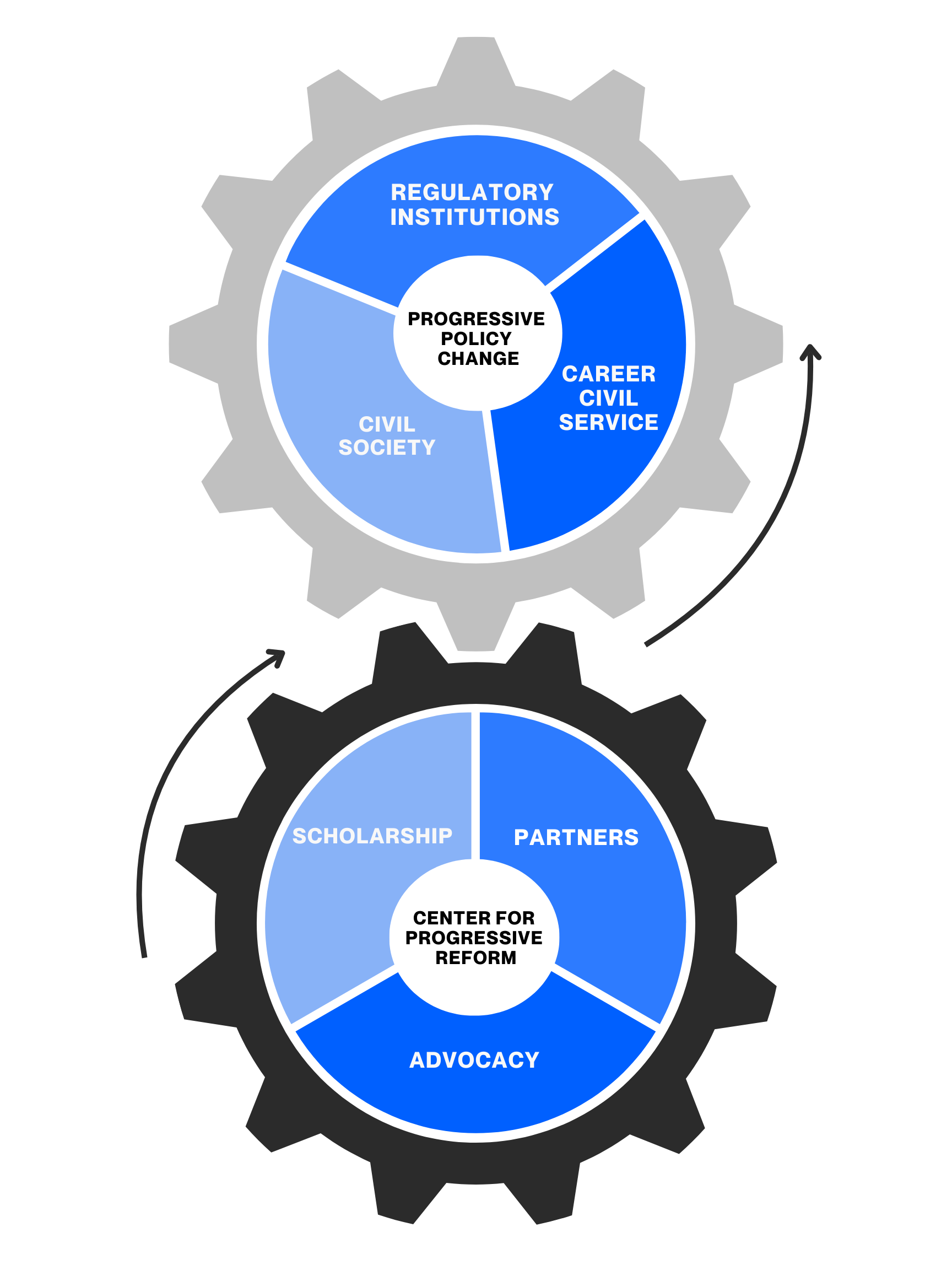
The rise of authoritarianism in parts of the public and private sectors has been met with deep frustration and policy paralysis in many spheres. Some in legal, advocacy, and activist circles have asked — In this landscape, does policy even matter? At the Center for Progressive Reform, we believe it — and a constructively reformed administrative state — are essential. We are uniquely positioned to bring such policy solutions to bear as one part of a larger, coordinated advocacy ecosystem.
Addressing the policy failures that drive our country’s social problems requires a lot of expertise. This includes rigorous scientific knowledge that can withstand industry attacks, as well as the legal and policy know-how to confront the obstacles standing in the way of public policy that equitably works for everyone.
We also recognize that policy solutions cannot accomplish their goals on their own. Widespread public support is needed to move elected and appointed officials to propose and pass constructive policies, and relationships across civil society are needed to get a sense of what we, the people, want and need. In short, what are people willing to show up and fight for?
The place where these interests and strategies meet is the administrative state — a unique nexus within our federal, state, and local governments where advocacy, scholarship, and power encounter each other, and where the public and agencies can and should work together. This is also where the Center for Progressive Reform’s staff and scholars have built a wide-reaching set of relationships and a robust expertise.
The Center envisions the administrative state as a durable relationship between the public and democratically accountable agencies that functions best when public power is able to translate into meaningful policy change. As such, our work focuses on policy reforms that strengthen both sides of this relationship so our institutions can work more robustly, effectively, inclusively, and fairly. We use our scholarship, advocacy, and collaborations with partners to promote effective engagement with the administrative state.
At the same time, we seek transformational reform of our administrative institutions and procedures to make them better equipped to incorporate that engagement and to better advance the public’s demands for racial equity and social justice. The progressive policy change these relationships create feeds back to the public in the form of improved general welfare and well-being (cleaner air, less polluted water, safer food, a more stable climate, stronger worker protections, and so on), as part of an overall dynamic in which the administrative state guards against concentrations of economic and political power by continually building and preserving power where it belongs — with the people.