

| Quick resources |
| Download the PDF |
With its decision in Loper Bright Enterprises v. Raimondo, the U.S. Supreme Court introduced a potentially massive shift in administrative law with respect to judicial review of agency rulemakings. Officially, Loper Bright overruled the then-existing jurisprudential framework — known as Chevron deference — for evaluating agency claims to legal authority in support of their proposed rulemakings (as opposed to the reasonableness of their policy rationale for the rulemaking, which is currently governed by the so-called “hard look” doctrine). Named after the landmark Supreme Court case Chevron v. NRDC, this doctrine counseled reviewing courts to defer to agency interpretations of ambiguous statutory authority so long as those interpretations were reasonable.
In its place, Loper Bright calls on courts to conduct de novo review of ambiguous statutory terms — that is, to identify the single best reading based on their own independent analysis using traditional tools of statutory construction. That single best reading would determine the legality of the agency’s rulemaking. In contrast, the Chevron deference approach implies the possibility of more than one permissible reading of an ambiguous statutory term, and a court would be obliged to uphold those permissible readings even if it finds they are not the “best.”
The legal commentary since the Loper Bright decision has explored whether and to what extent the change in doctrine translates into a sea change in jurisprudential practice. Overall, the emerging consensus seems to be that the new framework’s impacts on the substantive outcomes of cases have been more muted than anticipated, amounting to more of a shift in rhetoric than anything else.
This analysis takes a deeper look at how the new Loper Bright review framework has been applied in the lower courts during the first 14 months after the Supreme Court handed down the decision. It reveals how lower courts are continuing to wrestle with the complexities that the Loper Bright Court introduced into its articulation of that framework.
Still, based on the results of this analysis, it is possible to detect certain patterns in how cases are resolved within that framework. For advocates, these patterns may be valuable for informing strategies in how to approach comments on proposed rulemakings, as well as litigation regarding finalized rules.
Deconstructing the Loper Bright Framework
As noted above, the basic understanding of Loper Bright is that it establishes a regime of de novo review for ambiguous statutory terms that provide the asserted legal authority for agency rulemakings. The actual application of the framework is more complicated than that, of course, owing in no small part to several complexities arising from the majority opinion. As explained below, courts have used these complexities as key decision-making nodes for resolving cases. Note, however, that nothing like a systematic approach to applying the Loper Bright framework has emerged yet; indeed, the rigor of Loper Bright analysis has varied greatly across individual cases. Rather, such a framework can be pieced together, at least in theory, by reading the various cases in combination.
One important pattern that has emerged so far is that courts must resolve up to two preliminary issues before reaching de novo review. First, a court must determine whether the meaning of the statutory term at issue has been determined in a previous case using the Chevron deference framework. The Loper Bright majority memorably created an “offramp” from de novo review for such cases, asserting that statutory stare decisis insulated those terms against future legal challenges.
Second, a court must conclude that the term at issue is in fact ambiguous — that is, the term can be fairly read as supporting more than one meaning. This determination functionally mirrors Step 1 of the now-defunct Chevron deference doctrine.
Only after these preliminary questions have been resolved (i.e., no statutory stare decisis applies and the term at issue is genuinely ambiguous) does the court then proceed to de novo review. In practice, this standard of review calls on courts to independently determine the single best meaning of the term using all the traditional tools of statutory construction, including the term’s plain or ordinary meaning (i.e., as determined by reference to a relevant dictionary), broader statutory context, long-recognized canons of construction, and legislative history. (The relative weight that each of these tools carries will vary according to each judge’s particular interpretive philosophy.)
But even this formulation of the Loper Bright de novo regime elides two additional important technical issues that have proven influential in dictating the outcomes of several individual cases. First, the Loper Bright majority recognized the single best reading of a given statutory term could be that Congress intended to delegate some degree of decision-making discretion upon agencies. In such cases, the job of the court is to ensure that agencies have exercised that discretion reasonably by “polic[ing] the outer statutory boundaries.” Significantly, this inquiry functions similarly in many respects to Step 2 of the old Chevron deference doctrine — albeit in a more limited universe of cases.
The Loper Bright majority identifies three situations when Congress has delegated such discretion: statutes that expressly delegate to an agency the authority to define a term; those that charge an agency with “fill[ing] up the details” of a regulatory program; or those that employ some term or phrase clearly designed to impose flexible limits on agencies’ authority (e.g., “appropriate and necessary” or “in judgment of the… Administrator… which shall assure… protection of public health”). It is not clear whether this list of situations is merely illustrative in nature or is intended as comprehensive and exclusive.
Second, the Loper Bright majority indicated that courts could also take account of the agency’s interpretation when determining the meaning of an ambiguous term. Specifically, the majority pointed to its decision in Skidmore v. Swift, which explained that agency interpretations could “constitute a body of experience and informed judgment to which courts and litigants properly resort for guidance.” Such consideration of an agency interpretation has been referred to as “Skidmore respect.” That is because the Skidmore opinion counsels that the weight or “respect” a court grants to a given interpretation should be a function of “the thoroughness evident in its consideration, the validity of its reasoning, its consistency with earlier and later pronouncements, and all those factors which give it power to persuade, if lacking power to control.”
As the Loper Bright majority notes, it is this relatively limited capacity for persuasion that distinguishes Skidmore respect from the stronger default presumption established by Chevron deference. Still, the actual application of the various Skidmore factors — at least insofar as they are grounded in considerations of agency expertise and experience — has the practical effect of reducing the conceptual distance between Chevron and Loper Bright in many cases.
Significantly, the Loper Bright majority also indicated that there may be a few situations when recourse to an agency’s interpretation — and thus the application of Skidmore respect — may be particularly “informative” to the court. For example, this could include situations where an interpretation “rests on factual premises within [the agency’s] expertise” or that otherwise implicates the rulemaking agency’s “specialized expertise.”
Even with this guidance, the lower courts seem to be experiencing a great deal of confusion over where Skidmore respect fits in the overall Loper Bright de novo framework. Some courts appear to treat it almost as a variation on the traditional tools of statutory construction available to them — free to use or not as they see fit, with or without acknowledgment. Others have treated the situations outlined above (i.e., “rests on factual premises” or implicates “specialized expertise”) almost as preconditions that generally must be present in order for Skidmore respect to apply. Still, a few others treat Loper Bright almost as if it has reinstated Skidmore respect analysis as the prevailing mechanism for resolving statutory ambiguity. As such, they seem to regard it as obligatory to consider Skidmore respect factors in every case.
Finally, there are a few cases in which the court seemed to apply one or more Skidmore respect factors but did so without actually citing or referring to Skidmore by name. For instance, a court might credit a particular interpretation because it followed the agency’s consistent practice over a long period of time. While this is one of the factors in the Skidmore respect analysis, it is unclear whether this discussion was a conscious effort to apply this analysis or merely coincidental. For the purposes of this study, we categorized all such cases as including an application of the Skidmore framework even though some of them may have been unintentional. In either case, these circumstances suggest that studying the impact of the Skidmore framework in Loper Bright cases requires careful review.
The practical upshot is that not all cases that reached de novo review under the Loper Bright framework considered the Skidmore respect factors. Those that did consider the factors asserted different reasons for doing so.
There has also been some variation in how the courts have applied the Skidmore respect factors. In most cases, the courts have considered those factors only insofar as they bolstered the agency’s proffered interpretation of the ambiguous term. In a handful of cases, though, courts have been willing to weigh them against an agency’s proffered interpretation — for example, if that interpretation departs from past practice. In such cases, Skidmore is treated as a liability, rather than potentially as an asset.
Loper Bright in the Lower Courts by the Numbers
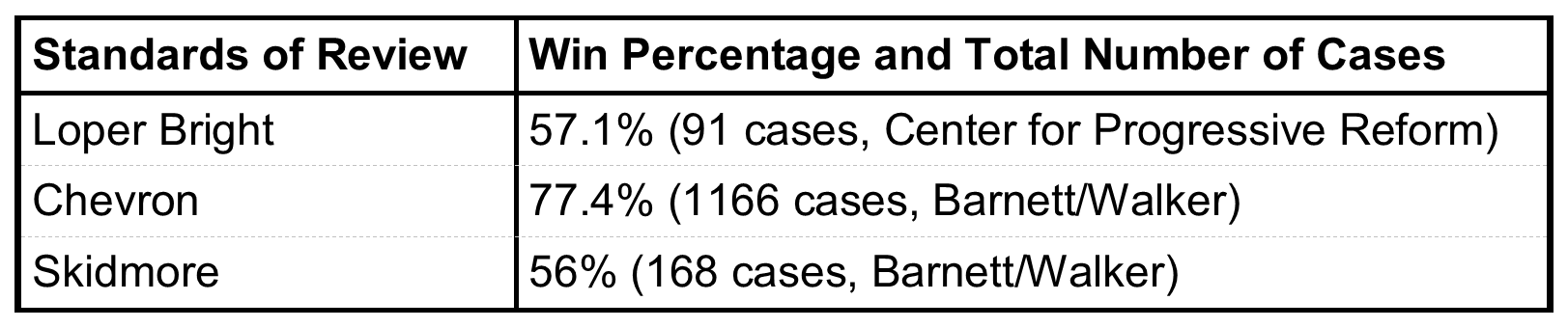
This analysis considers 91 lower court cases that substantively engage with at least one part of the emerging Loper Bright review framework outlined above. Overall, agencies “won” 52 of those cases (57 percent), where “win” means that the reviewing court agreed with the agency’s interpretation of the statutory provision on which the rule rested for its legal justification. (Note that this does not necessarily mean that the rule itself was upheld. A few were reversed for other reasons.) This represents a significant decrease in the win rate from Chevron deference cases, where various empirical studies placed the win rate at above 70 percent. (A 2017 study by legal scholars Kent Barnett and Christopher Walker places the agency win rate under Chevron at 77.4 percent.) This rate is roughly equivalent to agencies’ historic win rate under the Skidmore respect regime, which various empirical studies have found was in the range of 50 to 60 percent. (The same study from Barnett and Walker placed the agency win rate under Skidmore respect at 56 percent.)
Of those 91 cases, 24 were resolved before reaching the Loper Bright de novo review. The reviewing court determined that five of the cases were covered by statutory stare decisis, which meant that the agency’s interpretation was upheld under previous precedent. In the remaining 19, the court concluded that the statutory term at issue was not ambiguous, which also rendered de novo review unnecessary.
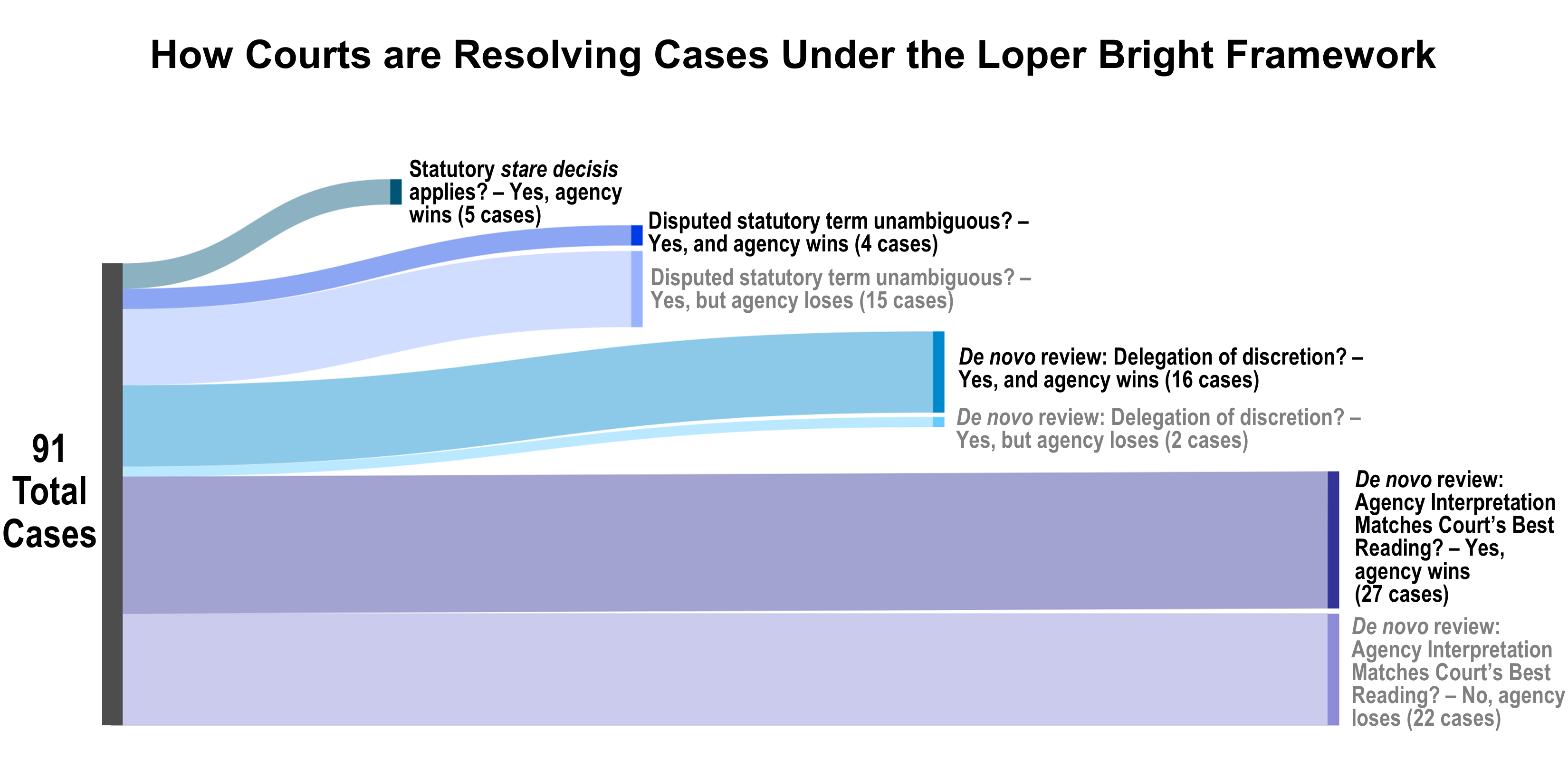
Overall, agencies fared very poorly when the statutory term was deemed unambiguous. Of those 19 cases, agency interpretations were upheld as consistent with the unambiguous language of the statute four times (19 percent). Significantly, this is the category of Loper Bright cases in which agencies had by far the highest loss rate.
Because what constitutes “unambiguous language” is hardly clear-cut, this high loss rate can help shape how agencies and advocates approach these cases, respectively. (Indeed, one of the criticisms of Chevron deference was that reviewing courts were too readily concluding that a given term was “ambiguous” at Step 1, thereby justifying resort to the framework’s deferential Step 2.) For agencies looking to survive judicial review, their litigation strategy can include efforts to persuade a reviewing court that key terms from the authorizing statute are ambiguous. This would open up the application of Loper Bright’s de novo review procedures where agencies tend to fare better, as noted below.
In contrast, for advocates looking to succeed in challenging a rule, they should explore opportunities in their public comments on a proposed rule and in their litigation strategy to argue that key terms are unambiguous and that the agency’s interpretation fails to align with that unambiguous meaning, which appears to be a more successful line of argument.
Of the 91 cases, 67 were resolved using Loper Bright’s new de novo review regime. Of these cases, agencies won 43 (64 percent) — a win rate that more closely resembles that which prevailed under the Chevron deference framework. But within this universe cases, there are still important nuances worth noting than can help guide commenting or litigation strategies.
To begin with, there is the category of cases in which a court determines that the “best reading” of a challenged term is that Congress intended to confer some degree of decision-making discretion to agencies. Of the cases studied, courts resolved 18 from this posture, and agencies won 16 (89 percent) of them. This is the category of cases for which agencies had by far the highest win rate.
Again, whether a given term can be construed as discretion-conferring will be open to debate in many cases. The examples provided in Loper Bright of such terms seem ripe for constructing analogies to other terms. Indeed, a review of the Loper Bright cases to this point reveals several challenged terms that arguably could have been understood by the reviewing court as intended to convey discretionary authority but were not. Examples include “offense,” “crime of child abuse,” and “subset of theft offenses.” Thus, an agency might seek to persuade a reviewing court that a key term warrants this treatment, thereby substantially increasing its chances of prevailing. Conversely, an advocate opposed to a rule might use their comments or litigation briefing to argue that a given term should not be interpreted as conferring interpretive discretion. .
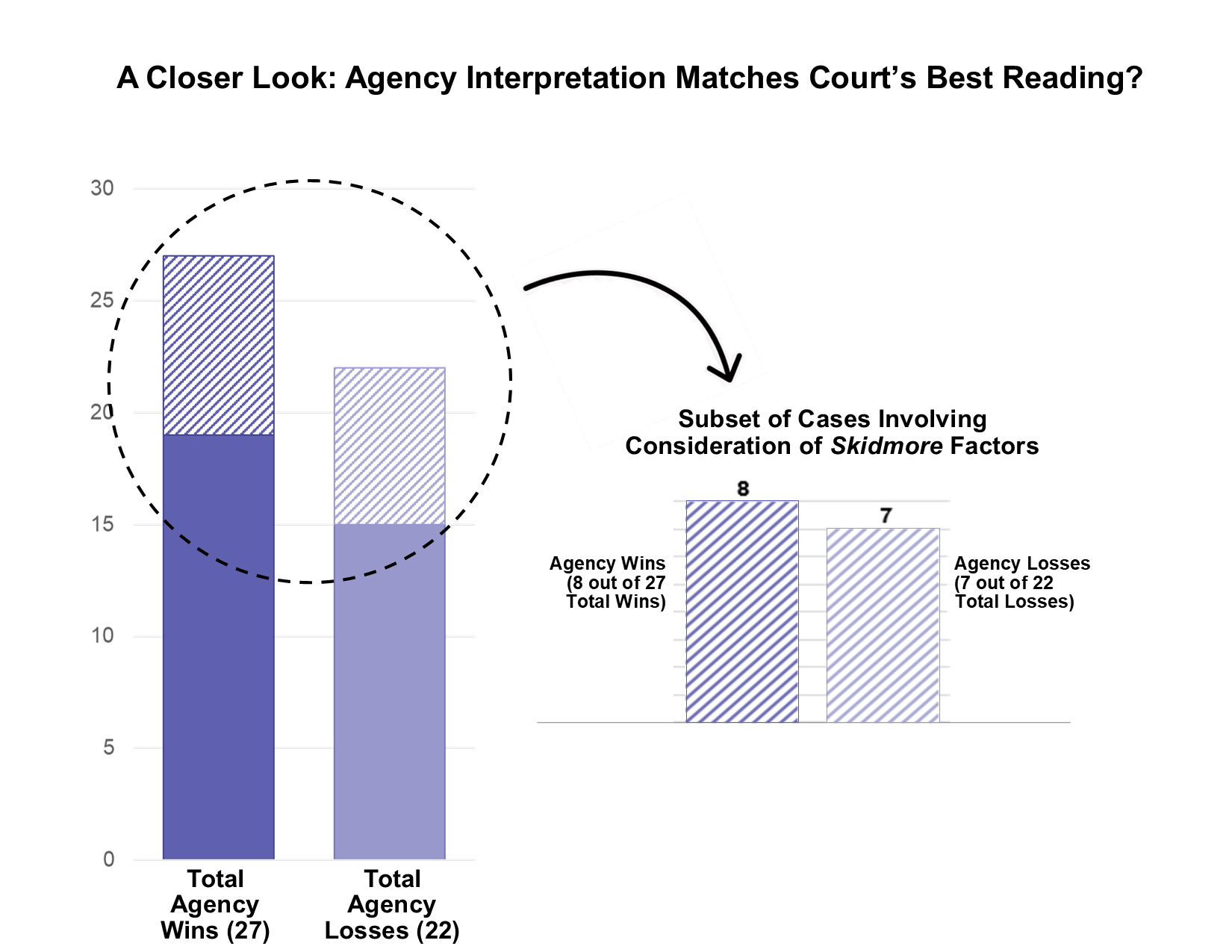
For the remaining 49 de novo cases, agencies still fare reasonably well, winning 27 (55 percent). Significantly, courts applied some element of the Skidmore respect framework in only 15 of those cases (31 percent). Agency win rates were roughly comparable in that subset of cases, with agencies winning eight (53 percent). In other words, consideration of Skidmore respect factors does not seem to appreciably alter the outcome of these cases. This suggests that heavy reliance on Skidmore may only be a marginally useful litigation or comment strategy for agencies and advocates and thus should not be a major priority.
One interesting note is that a few courts affirmatively used the Skidmore factors against an agency’s interpretation. In other words, their analysis was undertaken with the purpose of showing that a given agency interpretation was inconsistent with one or more Skidmore factors. This should provide a warning to agencies to carefully consider any liabilities that might arise from such an application of Skidmore factors. For advocates opposed to a given rule, they may wish to identify opportunities for leveraging such liabilities as part of their commenting or litigation strategies.
To recap:
- Agency win rates under Loper Bright (57 percent) are lower than under Chevron deference (70 percent or higher) but roughly comparable to historic win rates under Skidmore respect (between 50 and 60 percent).
- The dispositive issue on which agencies’ win rates have been the greatest under the Loper Bright framework is when a court’s de novo review finds that a given term was intended to confer decision-making discretion to the agency (89 percent).
- The dispositive issue on which agencies’ win rates have been the lowest under the Loper Bright framework is when the court determines that a given term is unambiguous, therefore obviating the need for de novo review (19 percent).
- The application of Skidmore respect factors has been episodic (31 percent of relevant cases) and does not seem to have an appreciable impact on the substantive outcome of cases (agency win rate of 55 percent in all relevant cases versus agency win rate of 53 percent in subset of cases in which Skidmore respect factors were applied).
