

| Quick resources |
| Download the PDF |
The Biden administration achieved something many deemed impossible: to pass legislation that would lay down the building blocks to address the climate crisis. This path would not be charted via regulatory mechanisms, but rather through a market-centered approach that stimulated the private sector. These legislative achievements included the Bipartisan Infrastructure Law (BIL), the CHIPS and Science Act, and the Inflation Reduction Act (IRA).
Critically, these laws conditioned some of the funding and tax credits on community benefits and improvements for marginalized groups. Relying on a strategy led by the private sector and enabled by the government, the Department of Energy (DOE) established funding opportunities — and their conditions — that sought to address obstacles related to manufacturing, structural bottlenecks, and social acceptance.
One of the main tools DOE relied on in the IRA and BIL grant process was the Community Benefits Plan (CBP) framework, which required that 20 percent of the points used to score proposals would be based on voluntary commitments to community and labor engagement, job quality, Justice40, and diversity, equity, inclusion, and accessibility (DEIA). In addition to this metric for grants, CBPs would be required for all Loan Programs Office (LPO) loans.
The inclusion of CBPs in DOE programming sought to ensure that projects receiving funding from the DOE had transparent and comprehensive community engagement processes, delivering tangible benefits to both workers and communities. Unfortunately, the second Trump administration has reversed course on or largely abandoned most of these goals.
What are CBPs?
Briefly put, in this context, a CBP is a plan demonstrating how an entity applying for public funds (like IRA or BIL funding) will ensure that a proposed project provides benefits to workers and community members. Critically, CBPs are not themselves legally binding, but requiring entities seeking public funds to develop these plans was understood as the first step toward legally binding commitments like a Community Benefits Agreement or Project Labor Agreement.
Those seeking funding received substantial support from DOE in order to craft successful plans. DOE provided specific guidance on the types of activities that aligned with their four priorities for CBPs, including (a) Community and Labor Engagement; (b) Job Quality and Workforce Continuity; (c) Diversity, Equity, Inclusion and Accessibility (DEIA); and (d) Justice40.
As part of the DEIA component of the CBP metric, applicants were encouraged to identify Minority, Women and Diverse Business Enterprise firms and Minority Serving Institutions as partners to contract with, which was a common explicitly stated commitment in the proposals. In terms of energy justice, CBPs were aimed at ensuring that structurally marginalized communities experienced material benefits from these investments and that strong labor practices were an integral part of the clean energy transition.
Role and potential of CBPs
Like many “wicked problems,” addressing structural challenges like racial and economic inequity or environmental degradation requires paying attention to the interdependencies or relationships between them, and thus, should be addressed under a common strategy. For example, addressing unemployment without strong quality or labor benefits would likely perpetuate existing patterns of exclusion in the job market. This is why conditioning loans and grants on the existence of community benefits held so much potential, by unifying and consolidating interdependent policy problems under one strategy.
Another important role for the CBP framework was getting ahead of potential implementation delays related to the lack of social acceptance, local opposition, or pushback from specific groups like labor unions. Instead of restricting veto points or opportunities for participation, the CBP framework sought to encourage transparency and accountability via increased engagement and responsiveness to local conditions.
Under the second Trump administration, however, these benefits are unlikely to materialize. Shortly after taking office, President Trump issued several executive orders (EOs) designed to roll back diversity, equity, and inclusion (DEI) and environmental justice initiatives pursued by the Biden administration. These directly targeted CBP requirements.
The consequences of these actions were immediate and shifted federal energy and infrastructure policy away from clear ways to articulate interrelated policy goals. Federal policy linking clean energy investments to local and community benefits would have translated into vast community benefits, rebalancing the relationship between the private sector, labor, and communities. This raises the question: what could have been achieved had these CBPs materialized?
To answer that question, we analyzed 251 DOE project factsheets (collected by Data for Progress) and extracted benefits included as part of the project. Although factsheets only provide a snippet of the specificities of the projects, they allow us to do an initial assessment of the potential benefits these projects were expected to have. We identified several categories of benefits, related to multiple environmental, labor, equity and justice, and financial dimensions. Specifically, we focused on the following categories:
- Education: captures explicit educational benefits broadly, such as access to academic opportunities, contributions to workers’ degrees and studies, and school-related benefits like increased school attendance.
- Employment: captures job creation and work benefits like retirement, daycare or other facilities for workers, or salary minimums.
- Workforce training: captures work-related or professional training that is directly related to the sector or industry of the loan recipient.
- Local infrastructure and housing: captures investments in local infrastructure (like buildings, local distribution, battery storage, micro-grids, etc.) and benefits directly related to people’s residences.
- Health and safety: captures community health and safety improvements and benefits, when mentioned explicitly in the factsheet. This category includes, for example, reduced exposure to toxins, lower risk of outages in healthcare facilities, or reduced wildfire risk.
- Environmental and climate: captures environmental and climate benefits, when mentioned explicitly in the factsheet.
- Financial: captures direct monetary benefits. For example, in the form of direct savings, direct reinvestment into the community, or the creation of funds for community members.
- Reporting/Monitoring Provisions: captures the existence of reporting or monitoring provisions, including community councils, overseeing organizations or government agencies, or channels for the dissemination of information.
- Enforcement/Accountability Provisions: captures the existence of enforcement or accountability provisions, including the consequences of not delivering on the commitments made in the project proposal and legally enforceable agreements.
- Union Jobs / Engagement: captures the commitments to hire union labor, the commitment to engage in project labor agreements or other forms of agreements with unionized workers, or commitments to stay neutral in the eventual case of unionization efforts in the workplace.
- DEIA: captures benefits related to diversity, equity, inclusion, and accessibility.
We hand-coded each factsheet to extract the sentence(s) that reflected the commitment or expectation of benefits for each category and binarized all the information into a presence-absence structure. Given the lack of detailed information and the difficulties in establishing a framework to rank radically different types of benefits, we opted for a conservative approach to not overestimate potential benefits where little specificity was provided.
It’s also important to note that to some extent, there is some overlap between some of these categories, especially as the benefits moved from more concrete (such as “union jobs,” where it is clear whether the grant or loan recipient plans to engage with union or labor representatives) to more abstract (such as “Health and safety,” where the contribution of myriad elements contribute to a person’s or community well-being). We followed the same “conservative” approach, seeking to minimize inferences or speculation terms of the potential project benefits.
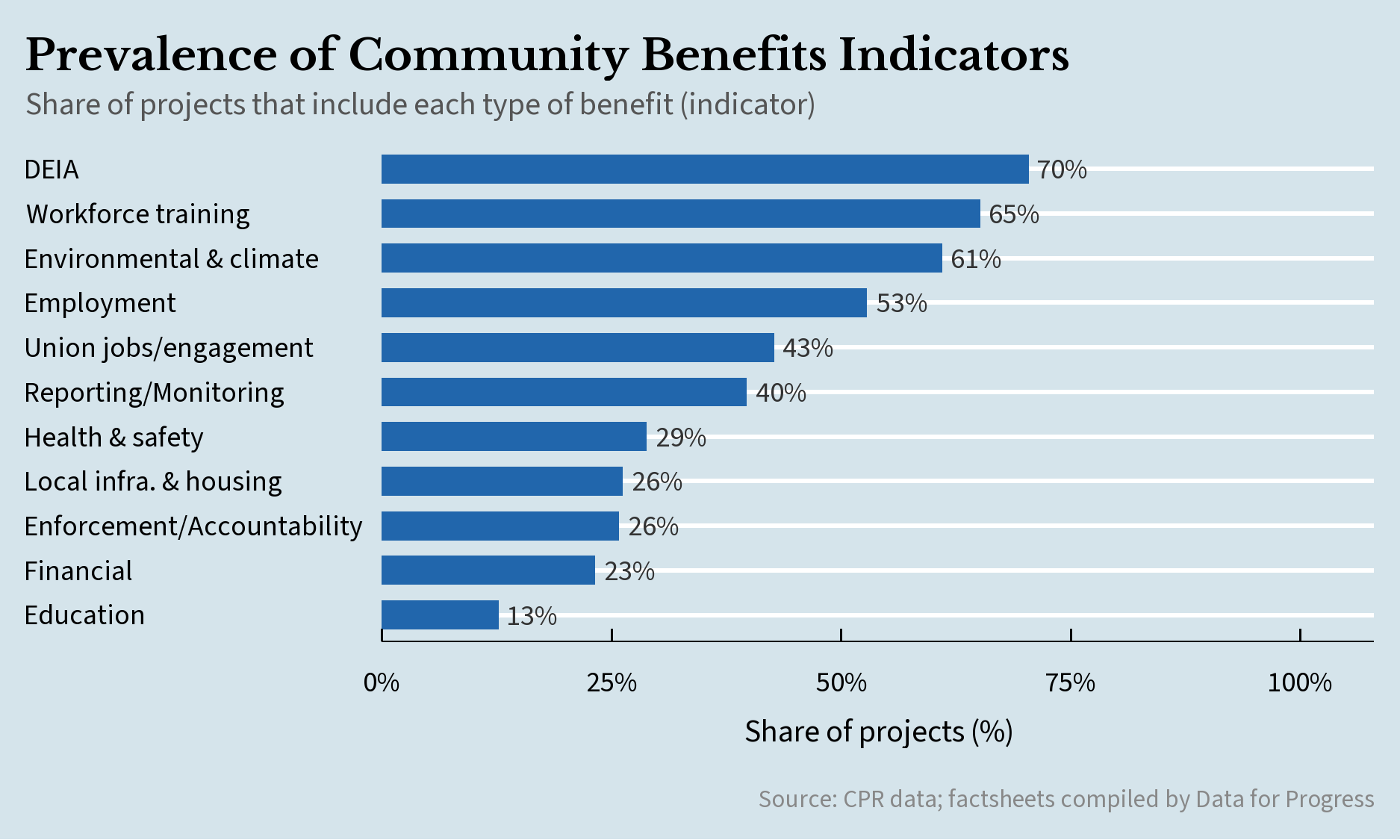
Figure 1 shows the prevalence of community benefit indicators. Among the most common benefits listed as part of the CBPs, DEIA, Workforce Training, Environment and Climate, and Employment are the most common, with a majority of projects expecting or committing to carry out actions that would move these goals forward. This shows the tight coupling in the CBP framework of what we call “Climate-DEIA-Labor nexus,” which represented the critical building blocks of the Biden administration’s approach to the energy transition.
Given the government programs behind the loans and grants groups applied for, it is not surprising that more than 60 percent of projects included DEIA and environmental and climate benefits. That so many projects also included workforce training benefits supports the idea that this approach can advance other policy goals related to a vibrant and future-oriented workforce.
Figure 2 shows the average number of benefit categories among projects for each sector. The center of the blue circle represents the average, whereas the size of the circle captures the number of projects in each sector. We also provided the minimum and maximum number of benefit categories for each sector, to show the spread of the data.
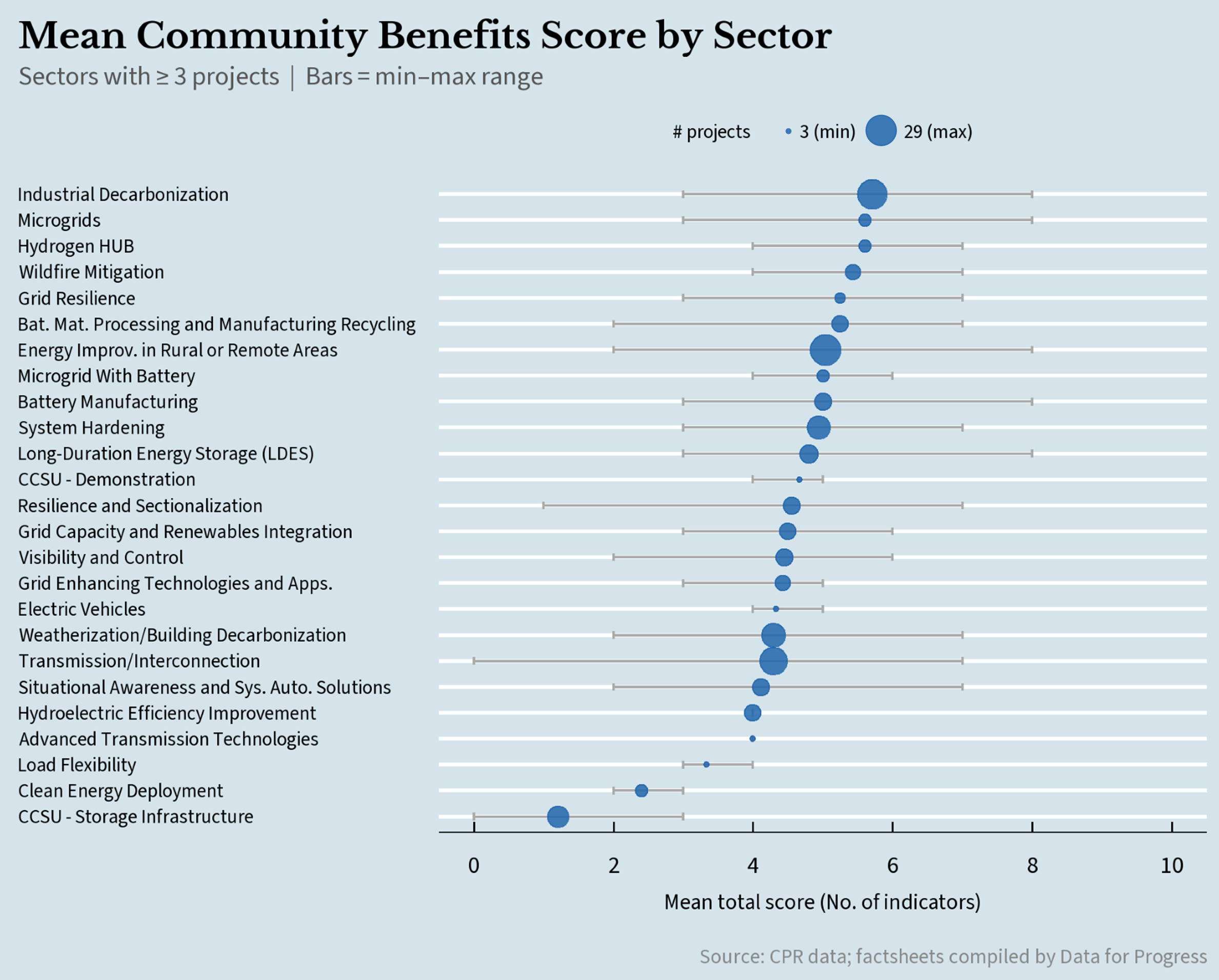
Energy Improvements in Rural or Remote Areas (29), Industrial Decarbonization (27), Transmission/Interconnection (24), and Weatherization/Building Decarbonization (17) projects were the most heavily represented, but given the difficulties in accessing data (or complete deletion of these by the Trump administration), we cannot infer that these proportions are representative of the entire universe of CBPs in existence. But it does provide a glimpse of the potential losses (or unrealized benefits) under a current administration that pivots away from or actively attacks these policy goals.
Industrial Decarbonization stands out as the sector with the highest average benefit score, followed by Microgrids, Hydrogen HUBs, Wildfire Mitigation, and Grid Resilience. These represent large-scale projects with extensive spillover effects that are intended to create multiplicative impacts in and around communities, so it is expected that a wider range of benefits would be explicitly mentioned in the factsheets. Importantly, only 11.6 percent of projects (29 out of 251) included less than three categories of benefits, showing that both the conceptualization of the CBP program (conditioning funding on multiple criteria) and the selection process (making CBPs 20 percent of the final project score) was promising and could have yielded tangible results.
These results must be interpreted with caution. Given the nature of the data (factsheets with brief descriptions of the projects) and the way the Trump administration has deleted information that during the Biden administration was publicly available, the aim of this article is to point out the lost opportunity that this reversal represents.
Finally, our results are partially driven by the way factsheets were developed (where formatting was relatively uniform within loan and grant programs, possibly driving specificity), which factsheets we were able to acquire and code, and which programs are represented.
The impact of Trump’s executive orders and other policies on the future of community benefits
The CBP framework was an innovative and flexible tool that allowed the Biden administration to tie together multiple policy goals to a single policy mechanism. Unfortunately, it was cut short before we were able to observe and measure its impacts.
In January 2025, Trump published Executive Order 14151 (“Ending Radical and Wasteful Government DEI Programs and Preferencing”), in which the Trump administration ordered federal agencies to terminate all DEI initiatives, including those embedded in DOE’s CBP framework. Also in January of that year, Trump published the executive order “Unleashing American Energy,” which, although it does not target CBPs explicitly, undermined the building blocks of several programs that were at the core of the CBPs.
EOs are not legally binding, but they do define and communicate an administration’s policy priorities. Thus, in response to these EOs, DOE issued internal memoranda instructing program offices to suspend CBP implementation and to amend existing grant and loan agreements to remove CBP provisions.
Specifically, DOE Office of Science published a memo on January 28, 2025, stating that they are “moving aggressively to implement” the executive orders by suspending “requiring, using or enforcing Community Benefits Plans (CBPs); and requiring, using or enforcing Justice40 requirements.” Additionally, DOE grants officers contacted grantees to renegotiate awards and strip CBP obligations that had required local benefits.
In a memo published by the Acting Head of Contracting Activity, Energy Efficiency & Renewable Energy on January 27, 2025, DOE advises that “recipients who have DEI and CBP activities in their awards will be contacted by their Grants Officer to initiate award modifications consistent with this Order.” Moreover, the agency told recipients that “[c]osts incurred after the date of this letter will not be reimbursed” for CBP-related activities, creating strong disincentives to pursue any commitments included in the plans.
These changes affected both project feasibility (through funding and permitting) and CBPs, putting their continuation and durability into question. Important changes to the Inflation Reduction Act funding under the 2025 budget reconciliation bill, along with the current 2027 budget proposal, directly undermine the financial viability of many clean energy projects. Companies that have secured grants or loans face a period of uncertainty, with hundreds of grants and loans already terminated by the administration.
Then there’s the issue of durability of CBPs. Materializing community benefits rests, partially, on a combination of incentives and enforcement, both of which are under siege. Let’s not forget that the provisions included in CBPs are voluntary and serve as a starting point for further negotiations. Plans to renegotiate or cancel awards and the DOE memo that Community Benefits Plans (CBPs) will not be enforced puts everything into question. Without enforcement, will project developers maintain their promises? If this is the case, we can rely only on “benevolent capitalism,” which does not have the best track record when it comes to the environment, labor, equity, or justice.
Although we cannot precisely estimate how much of these benefits have and will be lost with the data at hand, it is safe to say that many — perhaps most — of them will not see the light of day, or at least won’t to the extent that the coalitions that are reflected in the project proposals expected them to be. This disempowers communities on the ground, who are the ones that must coexist with the impacts of energy projects. Changing federal contracts to remove CBP requirements will severely undermine advancements to embed labor protections through different agreements — or commitments to develop them — reduced emissions, climate resilience, and other community benefits in alignment with Justice40 goals.
Despite its successes, there is work to be done to improve CBP implementation in the future. There is evidence showing that the way DOE offices structured the process mattered for achieving benefits. For example, some offices negotiated plans privately with applicants. Others built in phased funding with community checkpoints. This is a way to address the concerns of proponents of “building fast” without cutting out the public.
Finally, future administrations must align incentives for enforcement to take place. In conversations with former DOE officials, for example, it was clear that there was an inherent tension between maximizing implementation and withholding funds disbursement as an enforcement mechanism. Balancing these goals is not an easy task. In order to accomplish climate policy and energy democracy without putting them into conflict, a strategy that targets the “Climate-DEIA-Labor nexus” requires the continued alignment of diverse constituencies.
