
The Maryland Department of the Environment (MDE) recently issued a general discharge permit that covers pollution from most livestock farms, including concentrated animal feeding operations (CAFOs), across the state through July 2025. Unfortunately, the permit, which went into effect on July 8th, will likely jeopardize the 2025 nitrogen reduction goals under the Chesapeake Bay Total Maximum Daily Load (Bay TMDL) and does not align with Maryland’s Phase III Watershed Implementation Plan (WIP) commitments.
Roughly 95 percent of Maryland’s animal farms are located within the Chesapeake Bay watershed, so it is important that they are adequately regulated under the general permit – both so that local water quality can be protected and so the state can meet its pollution reduction goals under the Bay TMDL.

Source: Maryland Department of Agriculture "2020 AFO Permit"
These types of general permits serve two primary purposes: (1) they satisfy the requirement of the Clean Water Act that certain types of polluters obtain a National Pollution Discharge Elimination System (NPDES) permit, and (2) they allow state agencies to develop operating conditions with the goal of reducing water pollution for similar types of facilities discharging similar types of pollution within a certain geographic boundary, without having to undergo a site-by-site permitting process. Unlike individual permits, general permits are not developed with a specific facility and location in mind, but can still play an important role in minimizing water pollution if adequately drafted and implemented.
Maryland’s latest general CAFO permit outlines the conditions and requirements for animal farms of a certain size, including specifications for when and why pollution from a CAFO may be allowable without jeopardizing permit coverage. The permit primarily relies on the requirement that any covered farm develop a nutrient management plan (NMP) and conservation plan to reduce pollution.

Source: Maryland's Phase III WIP
The stakes are high for this process. The agricultural sector is responsible for the lion’s share of nitrogen pollution in Maryland's waterways. That pollution feeds algal blooms that choke off sunlight and create dead zones in the Bay, among other things. According to Maryland’s Phase III Watershed Implementation Plan (WIP), the state's farms and CAFOs were responsible for over 22 million pounds of nitrogen pollution in 2017. This WIP, which is a critical component of the Bay TMDL, calls for agricultural nitrogen pollution reductions, from 22.4 million pounds annually to 17.8 million pounds annually by 2025.
Yet nitrogen pollution levels on Maryland’s Eastern Shore, where a majority of the animal farms sit, are worsening. For instance, nitrogen pollution from broiler chickens alone increased by almost 30 percent between 2009 and 2018. This was due, in part, to the poultry boom that happened between 2014 and 2017 and the excessive amounts of manure that came along with it.
Source: CAST
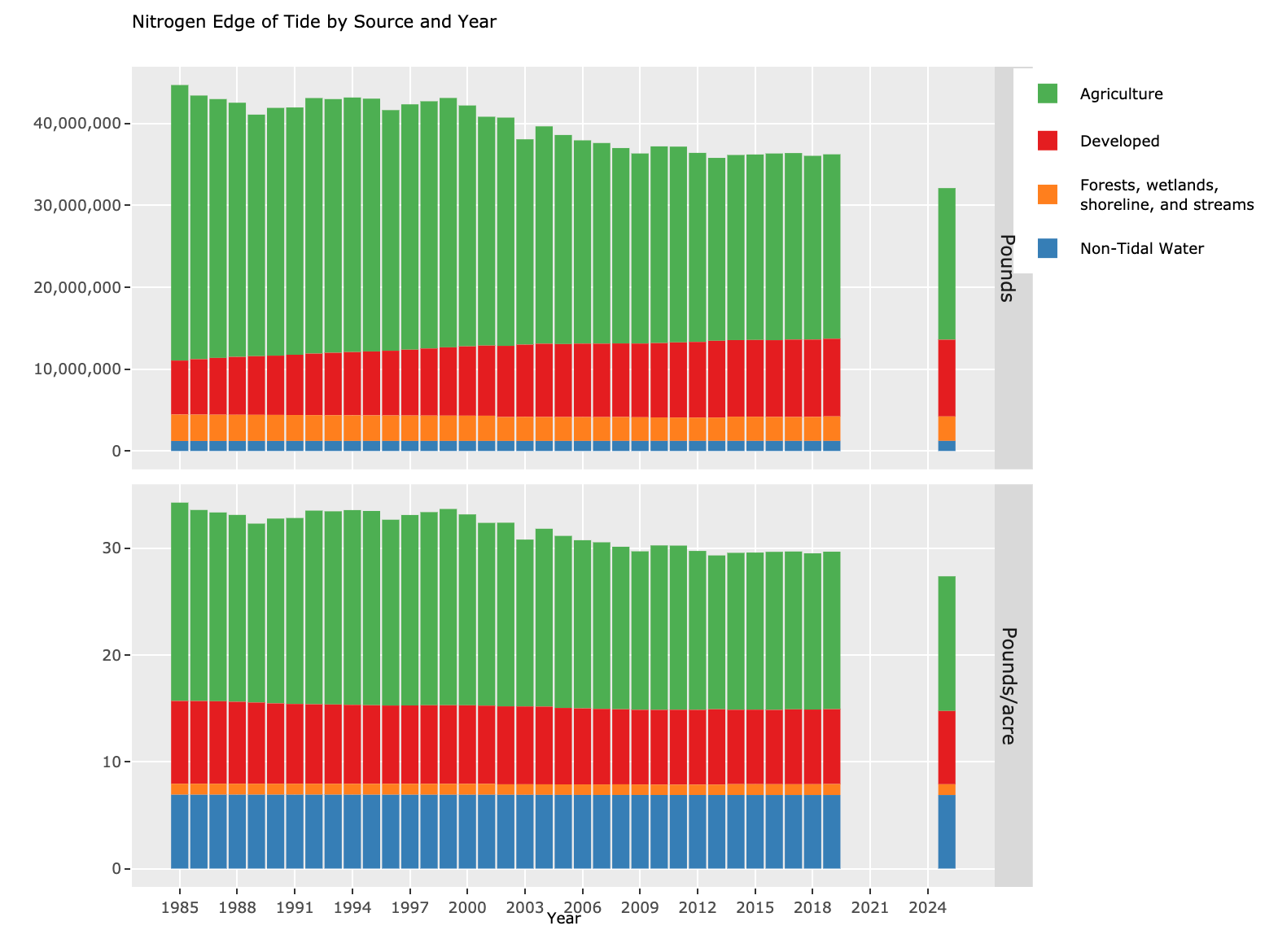
As the graph above demonstrates, agricultural nitrogen pollution in Maryland has not significantly decreased since the TMDL was implemented in 2010. That year, for example, agriculture was responsible for roughly 24 million pounds of nitrogen pollution into the state’s waterways. In 2019, that number dropped to approximately 22.5 million pounds (according to CAST). That 1.5 million pound decrease in one-year emissions is certainly progress, but the ten years it took to achieve it does not offer much hope that Maryland will meet its 2025 nitrogen pollution goals. Based on the state’s current annual nitrogen pollution levels, by 2025 Maryland will have had to reduce annual nitrogen pollution by at least 4.6 million pounds, triple the progress it has made over the last decade. We are less than five years out from the end of the Bay TMDL, meaning the state will have to expedite its progress by about six-fold. The status quo is clearly not enough to ensure Maryland achieves this goal.

(N=nitrogen, P=phosphorus, S=sediment)
Source: ChesapeakeProgress
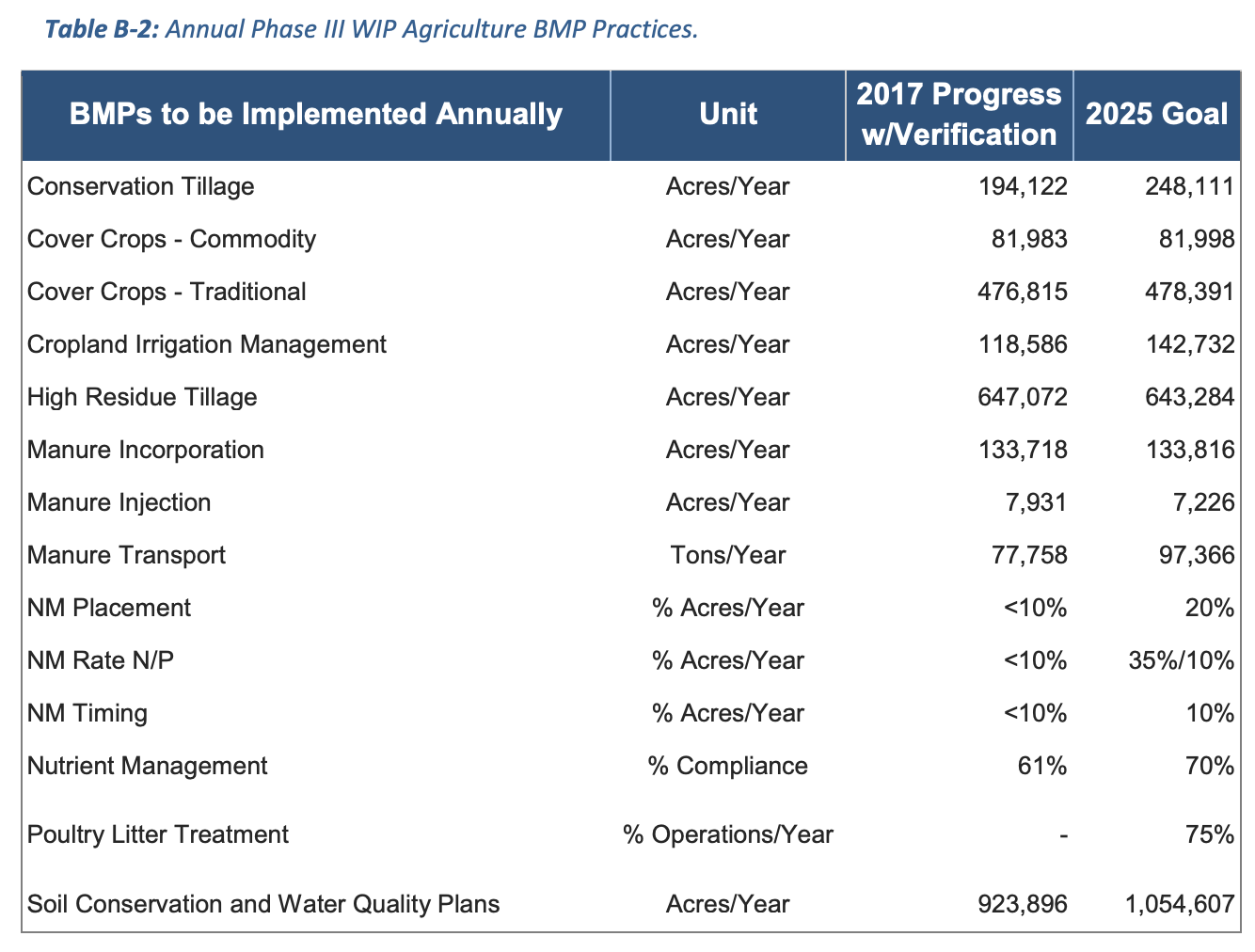
This lagging progress is not necessarily due to a lack of effort by farmers, many of whom have implemented dozens of best management practices (BMPs), including conservation tillage and pasture management, on hundreds of thousands of acres across Maryland. These practices are exactly how the state's agricultural sector was able to reduce its annual nitrogen pollution by 2 million pounds last year.
Instead, slow progress is likely due to a stagnation in state efforts to implement their WIPs, along with the insufficient regulation of CAFOs. Estimates show that poultry litter alone accounts for at least 12 percent of nitrogen in waterways on Maryland’s Eastern Shore, which is three times greater than the average for streams outside this area. The state will be unable to meet its goals without a substantial increase in funding for BMPs and significant changes in how it regulates livestock farms.
Source: Maryland's Phase III WIP
Despite objections from the public interest community, the final general CAFO permit does not include a number of key provisions that would help Maryland shift past the status quo to achieve its nitrogen reduction goals under the Bay TMDL, including Maryland’s Phase III WIP. The permit does not require emissions monitoring, adequate setbacks from waterways, controls consistent with TMDL wasteload allocations, public access to critical information, and a number of other key tools that would meaningfully limit pollution from CAFOs and provide for more synthesis with the Bay TMDL.
While the permit at least requires livestock farm owners to identify nearby waters that have TMDL impairments (i.e. for nitrogen, phosphorus, bacteria, or sediment), it contains discretionary language that does not require additional BMPs or controls consistent with those impairments or wasteload allocations. Even the EPA Permit Writers Manual for CAFOs says that “more stringent discharge limitations are necessary in instances where CAFOs discharge from a production area to a waterbody listed under CWA section 303(d) as impaired due to nutrients, dissolved oxygen or bacteria…”
Further, the Maryland permit requires the Comprehensive Nutrient Management Plan to address six resource concerns, such as appropriate storage of animal manure and proper mortality management, but it does not explicitly address runoff concerns for impaired waterways that may be nearby. In fact, the only references to the Bay TMDL or more localized TMDLs in the draft permit are a conclusory statement that “permit requirements are consistent with existing Total Maximum Daily Loads (TMDLs) for impaired water bodies,” followed by a note that “additional or alternative controls [such as BMPs] or monitoring may be required.”
Maryland’s Phase III WIP relies on nutrient management compliance to reduce 1.6 million pounds of nitrogen pollution per year. Yet the CAFO permit relies heavily on self-reporting and self-inspections, even though the Phase III WIP acknowledges that regulatory compliance of nutrient applications and proper waste management has “dropped the last few years.”
Compounding this problem, the permit does not include any transparency components that would help Marylanders better understand what progress livestock farms have made and will continue to make toward achieving the nitrogen reduction goals under the WIP. As the only permitted source of agricultural pollution, these farms' expected conservation practices should be clear and specifically tailored to water quality concerns, and the public should have access to information on whether farms and CAFOs are meeting the enforceable conditions of the permit. This type of transparency would assure the public that the pollution reduction commitments in the WIP are not hollow but will be upheld.
The general CAFO permit is a part of a broader policy scheme geared toward minimizing and reducing pollution impacts in the Chesapeake Bay watershed. This permit is absolutely critical to leveraging the quantity of pollution reduction from agriculture needed to achieve Bay cleanup goals. Unfortunately, MDE missed the mark.
